
Feeling Sound: Helping busy minds switch off
You've done the hard day.
The meetings, the decisions, the mental juggling act that never quite seems to end.
And yet, there you are at 11pm — lying in bed, eyes closed, mind still racing at full speed.
Sound familiar?
Here's an insight into what's actually happening under the hood. (And yes, there will be car analogies. Buckle up.)
Plus, keep reading for a free 30 minute sleepscape recording to aid deep rest tapping into binaural beats and the magic of solfeggio frequencies…
Your Brain Has Five Gears
I like to think of your brain similar to a car with five gears.
In the morning you're in fourth gear — Beta waves firing fast, sharp, and alert. Perfect for problem-solving and deadlines.
But just like you wouldn't leave a car in fourth gear and expect it to park itself, you can't sleep in it either.
So what does your brain actually need to wind down?
To drift into deep, restorative rest, it needs to move through the gears:
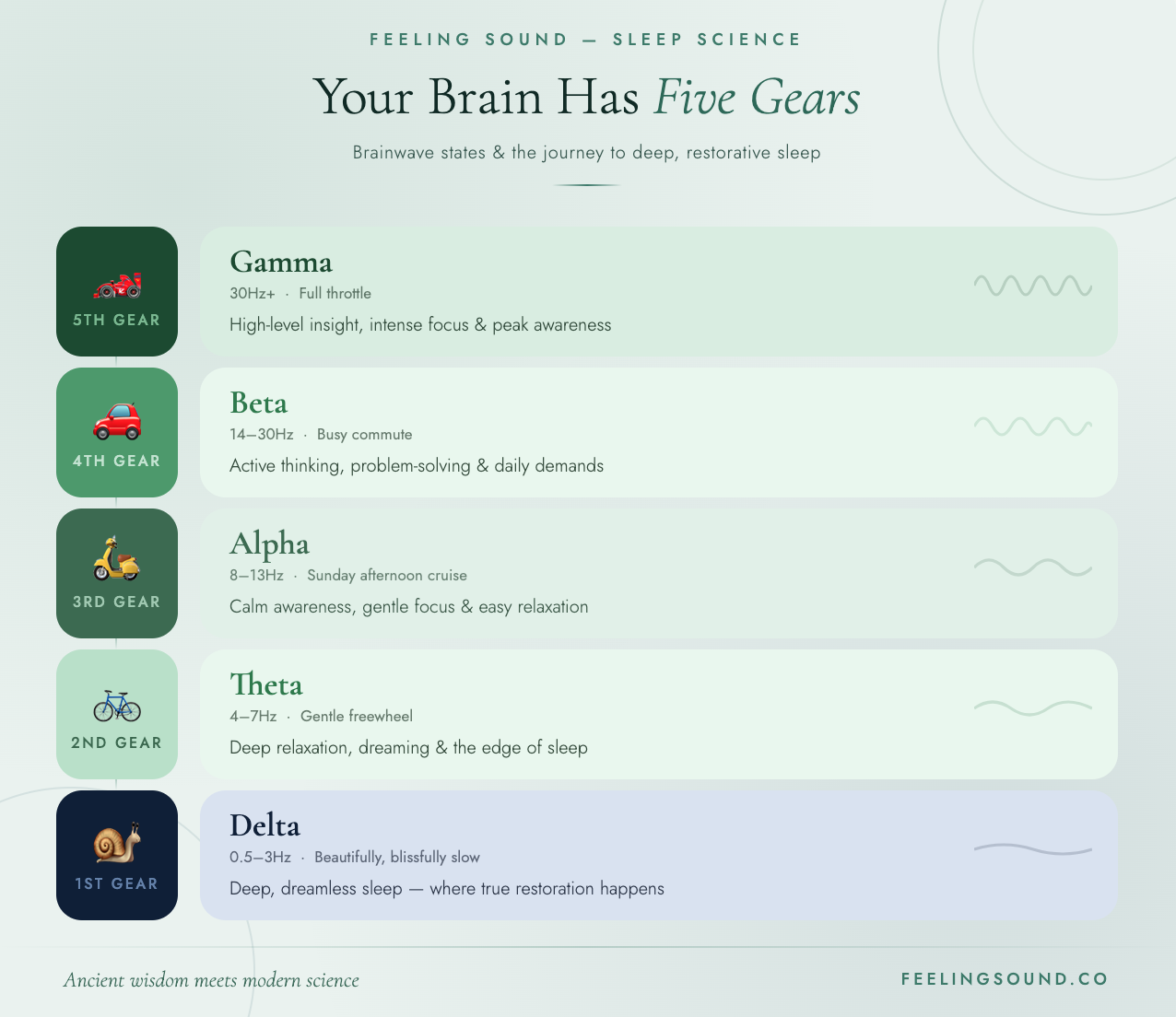
The problem for most busy professionals is that the jump from fourth to second feels almost impossible without help.
As I explored in my post on stress and the brain, most of us are stuck bouncing between Beta — busy, reactive, overloaded — and Delta, the exhausted crash at the end of it. Recognise yourself in there?
The middle gears, where real restoration lives, barely get a look in.
That's where meditation and sound therapy comes in. Consider me your very enthusiastic driving instructor.
Enter Binaural Beats
Ever put headphones on and felt your whole body exhale? There's actual science behind that.
Binaural beats are a clever acoustic trick. When you play two slightly different tones — one in each ear — your brain detects the difference and begins to synchronise to that frequency. It's called the frequency following response.
Play a tone at 200Hz in the left ear and 207Hz in the right, and your brain gently entrains to a 7Hz Theta state — that dreamy, second gear just above sleep. No effort, no willpower, no white-knuckling your way to relaxation. Just sound, doing what sound does best.
Research published in Frontiers in Human Neuroscience supports this, noting that binaural beat stimulation can shift brainwave activity and reduce anxiety, supporting the transition into more restful states.
This works through a process called audio entrainment — where the brain naturally synchronises its own electrical activity to match a rhythmic external stimulus.
Think of it like your brain's sat nav, locking onto a signal and recalculating the route.
Because binaural beats create the target frequency inside the brain itself rather than playing it directly through a speaker, the brain does the work without you having to consciously do anything at all.
You just listen. Your nervous system handles the rest.

Solfeggio Frequencies — Ancient Tones for Modern Minds
Ever heard a sound and felt it somewhere deep in your chest? That's not imagination — it's resonance.
Woven into many sound healing practices are solfeggio frequencies — a set of ancient tones believed to carry specific therapeutic properties.
The frequency 174Hz is associated with relieving physical tension and pain, and creating a sense of safety in the body — an ideal foundation for deep sleep. I think of them as tuning forks for the nervous system; subtle, but deeply felt.
Ancient technology, zero emissions.
The Parasympathetic Connection
Here's the bit that really makes sense of all of this. Why does sound work so well for sleep and stress? Because it speaks directly to your nervous system in a language it already understands.
Intentional sound helps activate the parasympathetic nervous system — your rest and digest mode — dialling down cortisol, slowing the heart rate, and signalling to every cell in your body: it's safe to let go now.
This is something Dr Herbert Benson spent his career proving.
A cardiologist and professor at Harvard Medical School, Benson was one of the first Western scientists to bring meditation into the lab in the early 1970s — at a time when the medical establishment largely considered it mysticism.
His research measured heart rate, blood pressure, oxygen consumption and brainwave activity in meditating subjects, finding consistent, reproducible changes every time.
He called it the relaxation response — describing it as "a physical state of deep rest that changes the physical and emotional response to stress — the opposite of the fight or flight response."
His landmark 1975 book of the same name was groundbreaking, making the case that the body has a built-in antidote to stress that absolutely anyone can activate.
Revolutionary stuff for the era — and it still holds up today.
His EEG research showed that meditation and sound therapy increase Alpha brainwave activity — third gear — reducing both stress and blood pressure in the process.
Sound like something your body's been waiting for? Yeah. I thought so too — it's why I do what I do.
Why My Approach Is Different
I'm Clare, founder of Feeling Sound — a sound therapist and meditation teacher with 20 years of experience and qualifications from both the British School of Meditation and the British Academy of Sound Therapy.
I’m here to help you rest, reset and enjoy exploring playful ways to switch off a busy mind.
My belief is that meditation shouldn't feel like another thing you're failing at.
Ever sat in a meditation class and spent the whole time wondering if you were doing it wrong? That won't happen in my sessions.
Everything I offer is trauma-aware, choice-led, and grounded in neuroscience — meaning you're never asked to force stillness or "empty your mind."
In these sessions we work with the latest scientific research. So that you can relax, knowing the guidance I offer is relevant, relatable and right.
“The quality of experience Clare offers is incredible — from her welcome, to her extraordinary ability as a musician and meditation teacher. It’s a calm, safe, genuine space and deeply therapeutic.”
Your 30-Minute Reset
Right then. Mirrors. Signal. Manoeuvre.
Before you drift off tonight, here's what I'd like you to do.
Check your mirrors — notice how you're actually feeling right now, without judgement.
Signal your intention — put your phone down, pop your headphones in, and decide that the next 30 minutes are yours.
Then manoeuvre — press play, close your eyes, and let the sound do the rest.
Below is a 30-minute sleepscape I've crafted with delta binaural beats and the 174Hz solfeggio frequency layered beneath ambient soundscapes.
No effort required. No experience needed.
Just a comfortable position and permission to shift all the way down into first gear.
Want to experience deep rest in person?
I run fortnightly drop-in sound baths and meditation sessions in Whaley Bridge and Old Glossop, as well as one-to-one sessions and beginner courses online.
Sessions start from just £12.50 — which is considerably cheaper than a coffee and cake at a motorway services, and significantly better for your nervous system.
References & Further Reading
Benson, H. & Klipper, M.Z. (1975). The Relaxation Response. William Morrow & Company. — Foundational research on the body's built-in antidote to stress, and the role of meditation in activating it. One of the first scientific studies of its kind.
Bhattacharya, J. & Bhattacharya, S. (2001). Binaural Beat and Brainwave Entrainment. — Early research into how binaural beats influence brainwave synchronisation and cognitive states.
Jirakittayakorn, N. & Wongsawat, Y. (2017). Brain Responses to a 6-Hz Binaural Beat: Effects on General Theta Rhythm and Frontal Midline Theta Activity. Frontiers in Neuroscience. — Explores the relationship between binaural beat stimulation and Theta brainwave entrainment.
Abeln, V. et al. (2014). Brainwave Entrainment for Better Sleep and Post-Sleep State of Young Elite Soccer Players. European Journal of Sport Science. — A fascinating study showing that young elite footballers who listened to binaural beat recordings fell asleep faster, slept more deeply, and felt more restored the next morning — even compared to athletes who already had good sleep habits. If it works for them, it'll work for you.
NHS (2022). Mindfulness. nhs.uk — Overview of the clinical evidence for meditation and mindfulness in reducing stress and anxiety.
Mental Health UK (2024). Burnout Report. — Documents the scale of workplace stress and its impact on mental health across the UK.
